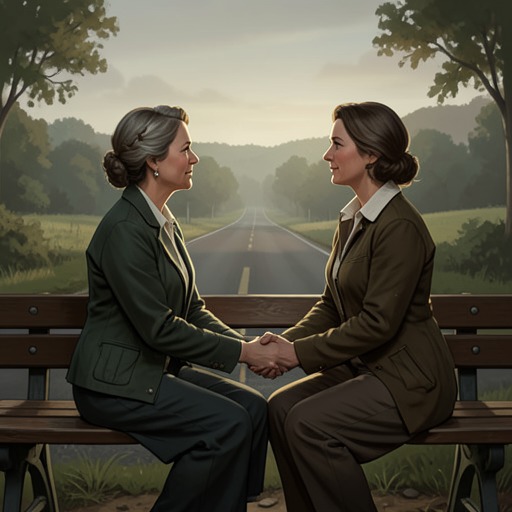
Yolandi and Julie’s friendship
All My Puny SorrowsYolandi and Julie’s friendship begins in childhood, is reinforced by kinship and family ties, and becomes one of the durable forms of care available to Yolandi as Elfrieda Von Riesen’s crises gather force. The relationship moves easily between irreverence and gravity: the two women trade stories and imagine a shared future, but Julie also rescues Yolandi from an icy riverbank, holds her through indecision, and stays beside her at the hospital. Their bond does not depend on having the same answer to an unbearable question; it depends on continuing to show up.
Childhood, Kinship, and Shared History
Yolandi and Julie grew up together in East Village. They are second cousins, and their mothers are best friends; the family connection extends further, since Elfrieda Von Riesen is also both Yolandi’s sister and cousin. The small number of Mennonite pioneers who came from Russia to Canada helps explain this interwoven kinship. Julie is therefore not simply a friend from the past: she belongs to a network of family relationships that has shaped Yolandi’s life from the beginning.
Their childhood intimacy is recalled with comic frankness. They bathed together, invented a game called Hide the Soap, and experimented by touching tongues. As they gradually understood that heterosexual adulthood would require them to do something similar with boys and men, the experiment became horrifying to them. The memory makes their friendship unusually candid: they can share embarrassment without polishing it into a respectable version of the past.
That candour persists into adulthood. When Yolandi and Julie sit together, they can talk about children, former partners, sex, loneliness, and fear without needing to make their lives sound tidier than they are. Their conversations give friendship the quality of a place where anxieties can be named, exaggerated, laughed at, and briefly set down.
Adult Life and the Friendship’s Private Future
Julie’s working life gives their closeness a grounded, practical texture. She is a letter carrier for Canada Post, walking fifteen miles a day with two twenty-pound bags of mail on her shoulders. In the rain, she sometimes opens a green street mailbox with a key from her large metal ring, sits inside, smokes, and listens to BBC News podcasts. Her supervisor reprimands her for this and other acts of insubordination, including rolling up the waistband of her Canada Post skort. Suspensions of one, two, or three days are acceptable to her: they can mean more time with her children before school instead of waking them in the dark and taking them to a neighbour’s house in their pyjamas.
After separating from her husband, Julie uses the Canada Post health plan to see a Jungian therapist. She is not presented as seeking treatment because her life is disastrous; she likes having room to talk about her feelings, goals, hopes, and disappointments. Her therapist calls her exceptionally optimistic and finds her dreamless sleep a challenge. Yolandi’s account of Julie holds this optimism beside her mischief, independence, and ordinary worries rather than treating any one of them as the whole person.
One evening, Yolandi and Julie drink cheap red wine and eat cheese and crackers on Julie’s porch, talking about nearly everything except Elfrieda Von Riesen. The subject has such a strong hold on Yolandi that she can hardly grasp it directly. Julie’s eight- and nine-year-old children, indoors watching Shrek, keep coming out to share their astonishment at the film. Each time, Julie throws her lit cigarette into the grass so they will not see her smoking, then retrieves it after they go back inside. Their belief that smoking causes AIDS becomes another source of wry conversation. Beneath the humour, the two mothers recognize how fiercely they worry about their children and how readily they blame themselves for each moment of unhappiness.
They also imagine a future in which, after their children have grown up and their parents and partners are gone, they will buy a house together in the countryside. They picture chopping wood, pumping water, fishing, playing piano, singing songs from musicals, revisiting their pasts, and waiting out the end of the world. The plan is partly comic, but its emotional promise is plain: neither expects the other to disappear when the demands of family life have passed. Their agreement gives the friendship a future tense, not just a shared past.
Care in Ordinary and Sudden Emergencies
The promise is confirmed through practical help. One winter, Yolandi crosses the frozen Assiniboine River, beside the family apartment, intending to climb the slippery bank near the Osborne Street Bridge. Wearing smooth-soled shoes, she cannot get a grip; thin branches snap when she tries to pull herself up, and she slides back to where she began. Lying on the ice and eating a granola bar, she remembers Julie’s spiked work shoes and calls her. Julie is nearby on her mail route and comes to help. She removes the shoes and throws them down to Yolandi, then stands on her mailbag to keep her feet dry while Yolandi climbs the bank in the spikes. They go for coffee and a Boston cream doughnut afterward. Julie’s rescue is not grandly dramatized: it is a phone call answered, the right equipment lent, and a small shared meal once the danger has passed.
In another period of strain, Julie’s domestic life offers a place to pause. On her back steps she shares smoothies made with mint from her garden, perogies, and salad from a chaotic kitchen containing bicycles and guitars. She has recently bought the house and is fixing it up; a dildo discovered behind a bathroom cabinet becomes an object of amused conversation. Julie mentions wanting to smoke a cigar despite a condition imposed by Judson, a man she has been seeing on and off since her separation. The two women laugh, too tired at that moment to confront the conditions placed on their relationships. This visit shows their familiar intimacy continuing amid changing homes and partnerships.
When Elfrieda is in intensive care, Julie comes to the hospital. Yolandi hugs her and whispers thanks; Julie squeezes her hard. The hospital permits visitors to enter only in pairs. Later, Julie and Yolandi pull chairs up beside Elfrieda and hold her hands. Elfrieda has a tube in her throat and a machine breathing for her; she looks back at them, shrugs, closes her eyes, and taps her forehead. Yolandi cannot tell what the gesture means. In the face of that uncertainty, Julie’s presence is itself a form of support: she stands with Yolandi without pretending that the sisters have words enough for the moment.
Disagreement, Loyalty, and the Limits of Help
Julie’s loyalty does not make her an unquestioning ally to every plan Yolandi considers. After Elfrieda’s crisis, Yolandi visits Julie’s porch and says she does not know what to do, asking whether Elfrieda will be all right. They drink wine and walk toward the riverbank, where they can see the distant towers, wings, and neon cross of Ste. Odile Hospital. Yolandi wonders which window belongs to her sister. Back on the porch, she raises the possibility of helping Elfrieda die. Julie tells her that she cannot actually do it, and when Yolandi imagines taking sole responsibility so that Nic and her mother would be spared, Julie does not endorse the plan. She says her gut instinct is that Yolandi should not do it; Yolandi replies that her own instinct is that Elfrieda will do it anyway. The conversation leaves their disagreement unresolved, but not their companionship: Julie listens through the whole terrible calculation rather than withdrawing from it.
The ethical conflict returns in another conversation about Switzerland. Julie objects that legality alone cannot establish that an action is right. Yolandi answers by arguing from individual autonomy and the reduction of suffering. Julie does not settle the philosophical dispute. Instead, she notices that Yolandi is hot and holds a frozen steak to her forehead. She offers to make her dinner and encourages her to stay, while Yolandi has to take family members to the hospital early for her aunt’s surgery. Later, Julie waits outside the airport in her car, then falls asleep with her arms full of the meat she has won. The comic image does not cancel the seriousness of the disagreement; it shows care continuing through it, expressed as food, transportation, and the willingness to remain nearby.
Julie also guards the confidence Yolandi has shared about the assisted-death discussion. When Yolandi warns that a serious conversation could be reported if it suggested the possibility of a crime, Julie promises not to tell anyone, including her therapist. She recognizes that Yolandi is trembling and can feel her heart pounding against her ribs. Nearby, a couple trade angry arguments about money, and a Frisbee sails past Julie’s head. The ordinary interruption sits beside the intimate disclosure without resolving it. Julie stays with Yolandi through both the bodily force of her fear and the absurdity of the surrounding scene.
A Friendship That Keeps Returning
Across these episodes, Julie’s role is neither to rescue Yolandi from every consequence nor to agree with her about what should happen to Elfrieda. Their friendship is stronger and more specific than simple affirmation. Julie can tease, offer practical care, challenge Yolandi’s judgment, keep a confidence, and return to the conversation afterward. Yolandi, in turn, trusts her with shame, fear, and thoughts she worries might implicate the people she loves.
The imagined country house and the actual icy bank form a telling pair. In the future they invent, Julie and Yolandi expect to share work, music, and the end of the world; in the present, Julie lends the shoes that let Yolandi climb out of a dangerous place. The friendship cannot make grief manageable or remove the moral burden surrounding Elfrieda’s wish to die. It can, however, give Yolandi someone to call, someone who will come, and someone who can remain beside her when no answer feels adequate.